Someone will grade your manifesto. It should be you.
Every government publishes a programme and then loses track of it. The scorecard gets built regardless — by a journalist, an NGO, or the opposition. The only real choice is whose numbers the public sees first.
One argument, twelve minutes, every figure sourced.
Read the full argument
The manifesto is the most carefully written document a party ever produces and the least used document a government ever owns.
It is drafted over months. It is argued over line by line. It is costed, at least notionally. It wins the election. And then, within about a year, it becomes something nobody can quite locate — a PDF on a party website, referred to in speeches, consulted almost never.
I have watched this happen in more administrations than I care to count, on both sides of the aisle, in countries whose politics have nothing in common. It is not a failure of sincerity. Governments do not abandon their manifestos out of cynicism. They lose them structurally, and the mechanism is worth describing precisely, because a problem understood structurally can be fixed structurally.
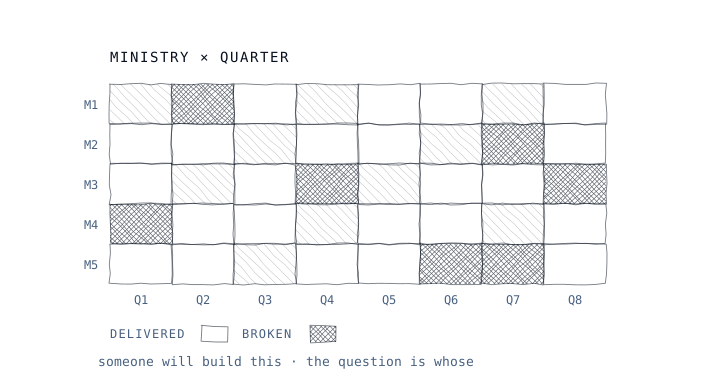
The scorecard, whoever ends up building it.
Every figure in this piece can be checked before you give us a name.
- 01Debt-to-GDP, upper-band Caribbean sovereigns — 90%, grade A. IMF WEO database, 2024.
- 02Interest payments as share of government revenue, high-debt cases — 25%, grade B. IMF Article IV consultations, 2022–2024.
Chamber 08 — The Mandate Compact
Turn the ruling party's manifesto into a signed, ministry-by-ministry delivery plan the PM can score every quarter.
- Ingest the manifesto and decompose it into pillars, pledges, and ministry-owned deliverables.
- Quarterly scorecards and a PM Report Card that grade every ministry from delivered to broken.
- Signed, versioned compact with a full audit trail — every revision snapshotted and diffable.

Adam Anderson is the founder of OPEN Interactive and the author of the GDPVision instrument. He writes for principals, not for procurement.
The region is being asked to replace half its revenue with the instruments of the last century.
Citizenship by Investment reaches half of government revenue in the upper band of five OECS states, and its phase-out has a date. The harder problem is that the region is being asked to engineer that transition using evidence that arrives eighteen months late.
Governing from a photograph.
Authoritative sector data reaches a Caribbean Cabinet roughly eighteen months after the period it describes. We ask governments to steer an economy using a picture of where it used to be — and then to defend the picture as though it were a window.
Ask a minister what their portfolio contributes.
In most governments that question starts a procurement. Weeks later a consultant returns a figure and the Ministry of Finance disputes it. Meanwhile one sector carries most of the economy and every other ministry is arguing blind.
Two hundred and twenty-six per cent, in a single night.
Hurricane Maria cost Dominica more than two years of national output in one evening. Every fiscal plan in this region is written inside a hurricane corridor. Almost none of them is rehearsed against one.
The date is set. The replacement is not.
Five OECS states built a revenue pillar that Brussels has now scheduled for demolition. The question is no longer whether to diversify. It is whether anyone has priced the hole.
Zero seats.
The OECS holds no votes on the body setting the global minimum tax. When the rules that price your economy are written elsewhere, the one thing still within your control is whether you arrive at the argument prepared.
What happened to the decision?
Minutes record what was said. They do not record what was decided, who carries it, or whether it landed. In economies where a quarter of revenue is spoken for before Cabinet sits, that gap is not untidiness. It is money.
We are exporting the people we need, and guessing at how to keep them.
Up to seventy per cent of tertiary-educated citizens have left the upper band of Caribbean states. Retention policy is written, announced, and only then discovered to have missed the people it was written for.