The date is set. The replacement is not.
Five OECS states built a revenue pillar that Brussels has now scheduled for demolition. The question is no longer whether to diversify. It is whether anyone has priced the hole.
One argument, twelve minutes, every figure sourced.
Read the full argument
There is a particular silence that follows a certain kind of meeting. I have sat in it more than once. A minister has just been told, politely and by someone from a larger country, that an arrangement their government depends upon will be ending. Not negotiated. Ending. The delegation thanks them for their time. And in the room afterwards, nobody speaks for a while, because everyone is doing the same arithmetic and arriving at the same answer.
Citizenship by Investment is that arrangement. Five OECS states operate a programme today. At the upper band, receipts reach half of government revenue — a figure drawn from IMF Article IV consultations across those five states, and one that should stop any reader who has not seen it before. Half. Not of a discretionary fund. Of revenue.
That money is not abstract. It is in hospitals. It is in schools. It is in the reserve that a small island reaches for in the weeks after a hurricane, when the roads are gone and the reinsurance has not yet arrived. And it now has a scheduled end.
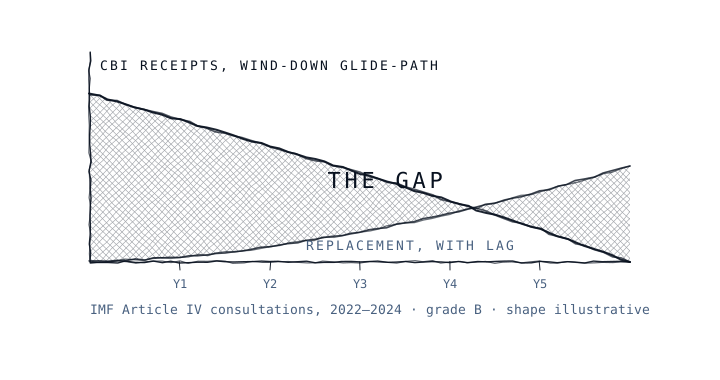
The Gap — receipts falling faster than the replacement arrives.
Every figure in this piece can be checked before you give us a name.
- 01CBI receipts as share of government revenue, upper band — 50%, grade B. IMF Article IV consultations, 2022–2024. Range across the five OECS CBI states.
- 02OECS states operating a CBI programme today — 5, grade A. St. Kitts & Nevis, Dominica, Antigua & Barbuda, Grenada, Saint Lucia.
Chamber 04 — The FDI Transition Studio
Replace fragile revenue with durable GDP through an assembled book of investment packages.
- The Gap: the revenue and GDP hole under the selected wind-down glide-path, year by year.
- Investment package builder with capital-to-GDP conversion and time-to-impact lags.
- Readiness scoring across legal, land, workforce, incentives, and institutional capacity.

Adam Anderson is the founder of OPEN Interactive and the author of the GDPVision instrument. He writes for principals, not for procurement.
The region is being asked to replace half its revenue with the instruments of the last century.
Citizenship by Investment reaches half of government revenue in the upper band of five OECS states, and its phase-out has a date. The harder problem is that the region is being asked to engineer that transition using evidence that arrives eighteen months late.
Governing from a photograph.
Authoritative sector data reaches a Caribbean Cabinet roughly eighteen months after the period it describes. We ask governments to steer an economy using a picture of where it used to be — and then to defend the picture as though it were a window.
Ask a minister what their portfolio contributes.
In most governments that question starts a procurement. Weeks later a consultant returns a figure and the Ministry of Finance disputes it. Meanwhile one sector carries most of the economy and every other ministry is arguing blind.
Two hundred and twenty-six per cent, in a single night.
Hurricane Maria cost Dominica more than two years of national output in one evening. Every fiscal plan in this region is written inside a hurricane corridor. Almost none of them is rehearsed against one.
Zero seats.
The OECS holds no votes on the body setting the global minimum tax. When the rules that price your economy are written elsewhere, the one thing still within your control is whether you arrive at the argument prepared.
What happened to the decision?
Minutes record what was said. They do not record what was decided, who carries it, or whether it landed. In economies where a quarter of revenue is spoken for before Cabinet sits, that gap is not untidiness. It is money.
We are exporting the people we need, and guessing at how to keep them.
Up to seventy per cent of tertiary-educated citizens have left the upper band of Caribbean states. Retention policy is written, announced, and only then discovered to have missed the people it was written for.
Someone will grade your manifesto. It should be you.
Every government publishes a programme and then loses track of it. The scorecard gets built regardless — by a journalist, an NGO, or the opposition. The only real choice is whose numbers the public sees first.